WEST NETWORKS  •  THE INFRASTRUCTURE EXPERTS (352) 316-7701  ·  SHOP PEPLINK →

Blog

  • No Failover on Show Day: Bond Everything You Can Get

    No Failover on Show Day: Bond Everything You Can Get

    There is no rehearsal for the moment 30,000 people arrive. The doors open once. So the guiding principle of event connectivity is simple and a little greedy: bond every link you can get your hands on, and never rely on a failover event.

    Why “more links” beats “a backup link”

    A backup link is a bet that one path stays perfect until it doesn’t. Bonding is the opposite bet: assume every path is imperfect, and run them all at once so their weaknesses cancel out. Venue fiber flaking, one carrier congested, a satellite dish shadowed by a stage — with a bond, each of those is a small dip absorbed by the others, not an outage.

    • Combined throughput on a good day — not an idle spare.
    • No visible switch, no reconnect, on a bad one.
    • Add any link on hand — another carrier, a borrowed drop — and enroll it in the tunnel; it strengthens the bond immediately.

    On show day you do not want a plan B. You want a network that never needed one.


    If your disaster-recovery plan includes the word “failover,” you’re doing it wrong.

    SpeedFusion internet bonding means increased performance, more uptime, and no failover — because the session was already riding every link.

    Own your network. Peplink hardware is bought once and it lasts — it keeps bonding and routing with or without an active warranty or the cloud. No forced subscriptions, no required licenses.

    Learn the fundamentals at connectivity101.com.

  • Live-Streaming Your Event to the World With WAN Smoothing

    Live-Streaming Your Event to the World With WAN Smoothing

    The audience in the room is only part of the audience. More and more, the real reach of an event is the livestream — and a stream that buffers or tears is worse than no stream at all. Bonded connectivity with WAN Smoothing is how you make an outdoor, no-infrastructure venue broadcast-grade.

    Why streams fail at events

    A single uplink at a crowded venue is fighting for the same spectrum as thousands of phones. Bitrate drops, packets are lost, and the encoder either stutters or drops resolution. Failing over to a backup link mid-stream just moves the glitch.

    Smooth the feed, spare the rest

    Put the stream on a dedicated sub-tunnel with WAN Smoothing: each packet is duplicated across links and the first copy to arrive wins, so a lost packet on one path is invisible. Everything else — uploads, comms, crowd Wi-Fi — rides a plain bonded tunnel so you are not paying smoothing overhead where it is not needed. Reserve the expensive protection for the pixels the world is watching.

    The result is a clean broadcast from a place that has no business supporting one.


    If your disaster-recovery plan includes the word “failover,” you’re doing it wrong.

    SpeedFusion internet bonding means increased performance, more uptime, and no failover — because the session was already riding every link.

    Own your network. Peplink hardware is bought once and it lasts — it keeps bonding and routing with or without an active warranty or the cloud. No forced subscriptions, no required licenses.

    Learn the fundamentals at connectivity101.com.

  • Pop-Up Enterprise Networks That Deploy in Hours, Not Weeks

    Pop-Up Enterprise Networks That Deploy in Hours, Not Weeks

    An event is an enterprise network with a brutal constraint: it has to appear in a field or a hall in a matter of hours, run flawlessly for a weekend, and disappear. There is no time to order circuits and no venue IT to lean on.

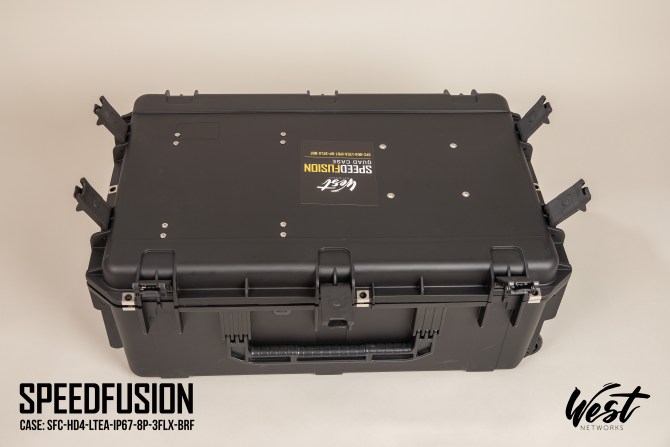
    A network in a road case

    A standardized Peplink kit — a bonding router, a managed switch, high-gain antennas, and access points — is a complete enterprise network you can ship, unpack, and power up. It brings its own internet by bonding cellular and satellite, so it does not depend on the venue having anything more than a parking spot.

    • Zero-Touch provisioning — a router can configure itself when it powers on, so kits ship straight to site.
    • Templated builds — the same configuration every time, so setup is muscle memory, not troubleshooting.
    • Remote eyes — InControl 2 lets your team watch and adjust every kit without being on the floor.

    Tear down, and the same kit is ready for the next event. You own it — no per-event circuit orders, no venue markup, no forced subscriptions.


    If your disaster-recovery plan includes the word “failover,” you’re doing it wrong.

    SpeedFusion internet bonding means increased performance, more uptime, and no failover — because the session was already riding every link.

    Own your network. Peplink hardware is bought once and it lasts — it keeps bonding and routing with or without an active warranty or the cloud. No forced subscriptions, no required licenses.

    Learn the fundamentals at connectivity101.com.

  • Registration, Payments, and Live Timing: The Three Things That Can’t Go Down

    Registration, Payments, and Live Timing: The Three Things That Can’t Go Down

    Every event has systems that are merely nice to have — and three that are load-bearing. If registration, payments, or live timing drop, the event itself is in trouble in front of a crowd. Design the network around those three first.

    Why these three break

    They all share one weakness: they assume a stable connection at the worst possible moment — peak crowd, peak congestion, peak stakes. A single venue drop or a saturated cell tower takes them all out at once.

    Bond first, then segment

    • Bond every link you can get — venue wired, multiple carriers, satellite — into one SpeedFusion pipe so no single failure lands.
    • Put the critical three on their own protected sub-tunnel with hot failover and, for timing feeds, WAN Smoothing.
    • Give the crowd Wi-Fi a separate lane so 20,000 phones never starve the payment terminals.

    The public network and the operations network ride the same bonded uplink but never compete — because you decided, in advance, which traffic gets protected when things get tight.


    If your disaster-recovery plan includes the word “failover,” you’re doing it wrong.

    SpeedFusion internet bonding means increased performance, more uptime, and no failover — because the session was already riding every link.

    Own your network. Peplink hardware is bought once and it lasts — it keeps bonding and routing with or without an active warranty or the cloud. No forced subscriptions, no required licenses.

    Learn the fundamentals at connectivity101.com.

  • Case Study: Bonding Six Starlinks to Run a Major Race

    Case Study: Bonding Six Starlinks to Run a Major Race

    A major fitness competition rolled into a Chicago venue in 2025 with the connectivity problem every large event shares: thousands of athletes and spectators, registration and live timing that cannot go down, and a venue whose infrastructure was never built for it.

    The build

    West Networks bonded six Starlink terminals with cellular into a single SpeedFusion tunnel. No one link had to carry the event; all of them did, together. As individual dishes and cell links wobbled under load and weather, Dynamic Weighted Bonding shifted traffic to whatever had headroom.

    The result

    Registration and live timing stayed up through the whole event. This is the distinction that matters on show day: not “we have a backup” (failover), but “we don’t go down” (bonding). A backup implies a moment of failure you recover from. Bonding means the moment never comes, because the workload was already spread across every path.

    For an event, that is everything. You cannot ask 5,000 people to wait while a link reconnects. The network either holds or it doesn’t — and bonded, it holds.


    If your disaster-recovery plan includes the word “failover,” you’re doing it wrong.

    SpeedFusion internet bonding means increased performance, more uptime, and no failover — because the session was already riding every link.

    Own your network. Peplink hardware is bought once and it lasts — it keeps bonding and routing with or without an active warranty or the cloud. No forced subscriptions, no required licenses.

    Learn the fundamentals at connectivity101.com.

  • Connectivity at a Golf Major, F1, and SailGP: Field Lessons

    Connectivity at a Golf Major, F1, and SailGP: Field Lessons

    West Networks has delivered connectivity for golf majors, Formula 1, SailGP, and other major sporting events: outdoor bonded 5G, private 5G, and large temporary WiFi deployments. These are the hardest rooms in the industry — tens of thousands of spectators, broadcast trucks with zero tolerance for a dropped frame, and venues that are, functionally, fields. Here’s what those deployments taught us, and why every lesson scales down to a 500-person conference or a county-fair-sized festival.

    Lesson 1: there is no venue line, and that’s a feature

    A golf major happens on a golf course. SailGP happens on water. There’s no exhibitor services order form because there’s no building — connectivity has to arrive with the production and work the day it lands. That constraint forced the right architecture: bond every path you can get — multiple 5G carriers, Starlink, any fixed circuit within reach — with Peplink SpeedFusion, into one connection with hot-failover and WAN smoothing.

    Here’s the reframe for indoor events: you’re not luckier for having a venue line, you’re just paying more. One real venue quoted $35,000 for 25 Mbps over 4 days — for a single wired path that is also a single point of failure. The field playbook, applied indoors, treats that line as optional: one more path in the bond if it’s cheap, skipped entirely if it’s $35,000.

    Lesson 2: the crowd is the RF environment

    At a major, the spectators aren’t just around your network — they are the propagation environment. Fifty thousand bodies absorb signal; fifty thousand phones saturate carrier sectors unevenly and unpredictably all day. What holds up: multiple carriers bonded so traffic routes around whichever sector is drowning; Starlink in the bond as a path the crowd can’t touch; antennas elevated above head height on masts and structures; and priority data plans instead of consumer SIMs. What never holds up: anything with one SIM in it.

    Lesson 3: separate the money traffic

    Broadcast contribution, POS, credentialing, ops, press, sponsor WiFi — at a major these are segmented networks with different priorities riding the same bonded core. The stream and the payment terminals get guaranteed treatment; press uploads get whatever’s left. Miss this and your revenue systems queue behind somebody’s 4K b-roll. On event hardware this is standard configuration, not custom engineering: a Balance 580X core with AP One Enterprise access points segments all of it out of the box.

    Lesson 4: stage everything before the truck rolls

    The deployments that go smoothly are decided a week early: SIMs activated and tested, configurations loaded, failover rehearsed, every unit remotely visible in InControl2 before it ships. On site, the sequence is power, antennas, verify — hours, not days. Zero-day deployment isn’t a slogan; it’s a checklist. This is also where an event-specialist partner earns its keep: we’ve stood in the 6 a.m. load-in fog, and we build kits so that moment is boring.

    Lesson 5: the same architecture, three sizes

    Everything above scales by subtraction, and the ROI math survives at every size:

    • Festival / stadium: Balance 580X with up to 8×5G modules + Starlink + AP One Enterprise WiFi — the full major-event pattern for POS, gates, ops, and streams.
    • Conference / production: MAX HD4 MBX, quad 5G bonded. ~$15,000 one-time + ~$250 per event versus that $35,000 venue quote: paid for in ~2 days, ~$34,750 saved every event after. Twenty events: ~$20,000 total versus ~$700,000 on rate cards.
    • Booth: MAX BR1 Pro 5G, dual-carrier, replaces $3,000–$9,000 of drops and SSID fees per show for ~$2,000 one-time.

    The events that broadcast to millions stopped renting infrastructure years ago; they bond connectivity they control. The only difference between them and your next event is scale — and the scale that matters, the ROI, actually gets better as you shrink: a 2-day payback needs no broadcast contract to justify it.

    Talk to West Networks →
    Shop the solution →

  • Why Hotspots Die in a 50,000-Person Crowd — and What Doesn’t

    Why Hotspots Die in a 50,000-Person Crowd — and What Doesn’t

    Every event professional has lived this: the hotspot that ran perfectly at 8 a.m. during load-in is a brick by 6 p.m. when the gates open. Nothing broke. The crowd showed up. That’s the whole story — and it’s why “we tried cellular once and it failed” is the most common objection we hear, and also the easiest one to answer.

    The physics of a dead hotspot

    A cell tower sector is shared capacity. When 50,000 people walk into a venue, they bring 50,000+ devices — most auto-uploading photos, streaming, and checking in — and every one of them competes for the same slice of spectrum your hotspot uses. Carriers add temporary capacity for the biggest events, but the ratio still collapses: sectors designed for hundreds of active users are suddenly serving thousands.

    A single-SIM hotspot has exactly one path through that congestion. When its carrier’s local sector saturates, the hotspot has no move to make. Your 20 payment terminals go down with it. At $40 an average ticket, 20 terminals dead for one hour is thousands of dollars in unsold merchandise and bar sales, plus the lines, plus the refunds, plus the tweet.

    So the objection is correct: one cellular connection dies in a crowd. The conclusion — “therefore cellular can’t work at events” — is wrong, for three reasons.

    Reason 1: carriers congest unevenly

    At any given moment during a show, Carrier A’s sector might be crushed while Carrier B has headroom — different spectrum holdings, different tower placement, different subscriber mix in that crowd. Congestion isn’t a weather system that hits everyone equally; it’s carrier-by-carrier, sector-by-sector, minute-by-minute.

    A Peplink MAX HD4 MBX runs four 5G modems with SIMs from multiple carriers at the same time. SpeedFusion bonding watches every path continuously — latency, loss, throughput — and steers traffic packet-by-packet toward whichever paths have capacity right now. When Carrier A’s sector saturates at gate-open, your traffic is already flowing over B, C, and D. Hot-failover means a dying path is abandoned in milliseconds; WAN smoothing means a live stream doesn’t even stutter while it happens. Need more than four paths? A Balance 580X takes up to 8×5G modules.

    Reason 2: Starlink doesn’t care about the crowd

    Add Starlink to the bond and you have a path that never touches the cellular towers at all. Fifty thousand phones can’t congest a satellite link they’re not using. For broadcast streams and POS — the traffic where failure costs real money — a bond of multiple 5G carriers plus Starlink means the crowd would have to kill every carrier and the satellite simultaneously to take you down. Ships at sea take this to the extreme, bonding 4–20 Starlinks into one pipe; a stadium parking lot is a gentle use case by comparison.

    Reason 3: engineering beats improvising

    The last difference between a consumer hotspot and a professional deployment is everything around the radios: elevated directional antennas placed above the crowd (bodies are surprisingly good RF absorbers — 50,000 of them matter), event-grade data plans with network priority instead of consumer SIMs, traffic segmentation so POS never queues behind press uploads, and remote monitoring so a degrading path is seen before it’s felt. This is the playbook West Networks has run at golf majors, Formula 1, and SailGP — RF environments as hostile as they come, with live broadcasts riding on the result.

    The math, because we always show the math

    The kit that survives the crowd is the same kit that beats the rate card. One real venue quote: $35,000 for 25 Mbps over 4 days. The HD4 MBX: ~$15,000 one-time plus ~$250 per event — paid for in about 2 days of event one, then ~$34,750 kept per event, forever. Over a 20-event horizon that’s ~$700,000 rate-card versus ~$20,000 owned. You don’t have to choose between reliable and cheaper; in this architecture they’re the same purchase.

    The next time someone says “cellular dies when the crowd shows up,” agree with them — then ask how many carriers, how many modems, and whether there’s a satellite in the bond. The answer to a shared-capacity problem isn’t avoiding wireless. It’s refusing to depend on any single slice of it.

    Talk to West Networks →
    Shop the solution →

  • The $35,000 Internet Bill: Inside Venue Rate Cards | EC101

    The $35,000 Internet Bill: Inside Venue Rate Cards | EC101

    Here is a real quote an event team received from a venue: $35,000 for 25 Mbps of dedicated bandwidth over 4 days.

    Do the arithmetic before the sticker shock wears off. That’s $7,500 per day. It’s $300 per day, per megabit-class of service. The phone in your pocket, on a decent 5G signal, will outrun 25 Mbps without trying. The venue was charging a Ferrari price for a golf cart, and — here’s the part that matters — the event almost paid it, because “that’s what venue internet costs.”

    It isn’t. It’s what renting the venue’s infrastructure costs. Those are different things, and the difference is worth six figures a year to anyone who does events for a living.

    What the rate card actually says

    Pull any major venue’s exhibitor services order form and you’ll find the same structure:

    • Hardline drops: $800–$2,500 each. That’s per cable, per event. A modest production with three drops pays $2,400–$7,500 for copper it hands back at load-out.
    • WiFi SSIDs: $500–$1,500 each. You’re paying four figures to rent a network name.
    • Dedicated bandwidth: $10,000–$35,000+ depending on speed and days. Our $35k/25 Mbps example is not an outlier; it’s a data point from a real order form.
    • Deadlines and late fees. Orders are typically due 30 or more days out. Miss the deadline — because your client changed the show scope, which clients do — and the late penalty runs 20–40%.

    And after you pay all of it, you get one wired path. One cable, one conduit, one contractor. If it fails mid-keynote, your recourse is a service ticket.

    Why this pricing survives

    Venue internet is priced like this because it can be. The exclusive show-services contractor faces no competition inside the building, the cost lands late in the budget cycle when nobody has energy to fight it, and the buyer believes there’s no alternative. For twenty years, there mostly wasn’t.

    Then two things changed: 5G got fast and plentiful across multiple carriers, and Peplink’s SpeedFusion made it possible to bond several of those connections — plus Starlink, plus any wired line you already have — into a single, unbreakable connection. This is what we call the New Enterprise approach: stop building infrastructure, start bonding connectivity.

    The owned alternative, priced honestly

    The workhorse for production-scale events is the Peplink MAX HD4 MBX: four 5G modems, running SIMs from multiple carriers simultaneously, bonded by SpeedFusion into one connection with hot-failover and WAN smoothing.

    • Hardware: ~$15,000, one time. You own it.
    • Service and data: ~$250 per month-or-event.
    • Bandwidth: hundreds of Mbps aggregate — routinely 10× that $35k “dedicated” line.
    • Deployment: the day you arrive. No order form, no deadline, no late fee.

    Now run the math the way a CFO would:

    Horizon Venue rate card Owned bonded kit You keep
    Event 1 $35,000 $15,000 + $250 = $15,250 $14,750
    5 events $150,000 $16,250 $133,750
    20 events $700,000 $20,000 $580,000

    Look at event one again. The venue was going to charge $35,000 for 4 days — $7,500 per day. The kit costs $15,250 total. By the end of day 2, the hardware has fully paid for itself against the fee you didn’t write a check for. From event two onward, your connectivity line item is roughly $250 instead of $35,000: ~$34,750 saved per event, forever. There aren’t many purchases in the event business with a payback period measured in days.

    “But we’ve been burned by cellular”

    You’ve been burned by a single cellular connection — one SIM, one carrier, one hotspot, dying the moment the crowd arrived. Bonding is the opposite architecture: four modems on different carriers, traffic steered packet-by-packet to whichever paths have capacity, with Starlink available as a path that never touches the congested towers at all. It’s the architecture West Networks has deployed at golf majors, Formula 1, and SailGP — environments where 50,000+ devices are fighting for spectrum and failure is broadcast live. (We cover congestion in depth in the next post in this series.)

    What to do with your next rate card

    Don’t throw it away — bring it to us. We’ll put it next to an owned-kit quote, line by line, with a payback date on it. If your venue quote is smaller than the kit, we’ll tell you that too; the math is the math. That’s the whole point of a site called 101: we teach, you decide.

    Talk to West Networks →
    Shop the solution →